
A console table is one of the most versatile pieces of furniture you can own — slim enough to fit almost anywhere, useful enough to earn its place in every room. It can welcome you in the hallway, anchor a wall in the living room, sit behind a sofa, or serve as a dressing table in the bedroom. This guide covers what a console table is, where to put it, how to choose the right size, and how to style it beautifully.
In short: a console table is a long, narrow table designed to sit against a wall or behind a sofa. Most are 75–90 cm tall and shallow — usually 25–40 cm deep — with width chosen to suit the wall or sofa it accompanies. The details below help you get all three right.
What is a console table?
A console table is a slim, elongated table built to be placed against a wall rather than in the middle of a room. Its shallow depth is the defining feature: it offers a useful surface and a focal point without taking up much floor space, which is what makes it so adaptable.
Where to put a console table
- Hallway or entryway. The classic use — a place to drop keys, set a lamp, and make a strong first impression as you enter the home.
- Behind a sofa. Positioned against the back of a free-standing sofa, a console defines the space and adds a surface for lamps or styling.
- Living room wall. As a slim alternative to a sideboard, a console anchors a wall and creates a spot for art, a mirror, and a few considered objects.
- Bedroom. A console makes an elegant, compact dressing table or a minimalist surface beneath a mirror.
Console table dimensions
The right dimensions depend on where the table will go, but these ranges cover most situations:
- Height: 75–90 cm. Around waist height works well in a hallway.
- Depth: 25–40 cm. Slim enough to keep walkways clear.
- Width: typically 80–120 cm, chosen to suit the wall or sofa.
Getting the height right
For a hallway or living-room wall, waist height — roughly 80–90 cm — feels comfortable and looks balanced. If the console will sit behind a sofa, aim for a height that’s level with, or just below, the top of the sofa’s backrest, so the two read as a considered pair rather than competing for attention.
Getting the width right
Width is about proportion. Against a wall, a console should relate to the space around it — leaving room on either side rather than crowding the wall edge to edge. Behind a sofa, it generally looks best when it’s a little shorter than the sofa itself. For a hallway, measure the wall and allow clearance so doors and walkways stay clear.
This is why our console tables are offered in 80, 90, and 100 cm widths — so you can match the piece to your wall or sofa precisely, instead of forcing a single fixed size into the space.
How to choose the right size for your space
Before buying, measure three things:
- The wall or sofa length the console will sit against, so the width is in proportion.
- The walkway clearance in front of it — especially important in hallways, where depth matters most.
- The height of nearby elements — the sofa back, a radiator, a light switch — so nothing clashes.
When in doubt, err on the slimmer side. A console’s elegance comes from being unobtrusive.
How to style a console table
A well-styled console looks effortless, but there’s a simple logic behind it. The key is balance and restraint — especially if you love a calm, natural aesthetic.
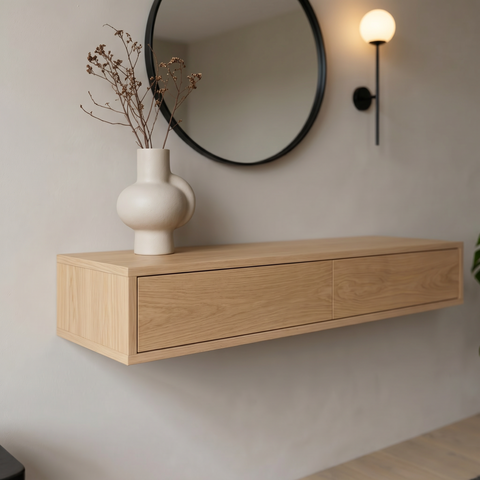
- Anchor the wall above. A mirror or a single piece of art above the console grounds the arrangement and adds height. A mirror also bounces light — ideal for darker hallways.
- Work in layers of height. Combine something tall (a lamp or a stem of greenery), something medium (a stack of books, a sculptural object), and something low (a tray or a small bowl).
- Use the rule of thirds. Group objects in odd numbers and offset them, rather than spacing everything symmetrically across the surface.
- Add a tray. A tray corrals small items — keys, a candle, a dish — and keeps the surface looking intentional rather than cluttered.
- Leave breathing space. The most important rule of all: don’t fill every centimetre. Empty space is what makes the styling — and the oak grain — feel considered and calm.
This pared-back, natural approach is at the heart of Japandi style. If it appeals to you, read our guide to what Japandi style is.
Console tables for small hallways
In a narrow hallway, depth is everything. Choose the slimmest console that still works — around 25–30 cm deep — and keep the styling minimal: a lamp or a small dish, a mirror above, and little else. A floating or leggy design can also make a tight space feel more open by keeping the floor visible beneath.
Choosing a console table that lasts
Because a console is often the first thing you see when you enter a home, material matters. A solid oak console brings warmth and presence, and stands up to years of daily use — keys dropped, lamps moved, life happening around it. At FUKUI, each console is handcrafted from solid oak in Poland, offered in three widths to suit your space. Explore the full range of console tables, discover the thinking behind the brand on our About page, or learn how to keep oak looking its best in our oak care guide.
Frequently asked questions
What is a console table used for?
A console table is a slim, wall-facing table used in hallways and entryways, behind sofas, along living-room walls, or as a compact dressing table in the bedroom. It offers a surface and a focal point without taking up much floor space.
What height should a console table be?
Most console tables are 75–90 cm tall. Waist height suits a hallway, while a console behind a sofa should sit level with or just below the top of the sofa’s backrest.
How deep should a console table be?
Console tables are typically 25–40 cm deep. In narrow hallways, choose the slimmer end of that range to keep walkways clear.
How wide should a console table be?
Width should suit the wall or sofa it accompanies — commonly 80–120 cm. Behind a sofa, a console usually looks best slightly shorter than the sofa itself.
How do I style a console table?
Hang a mirror or art above it, layer objects in varying heights, group items in odd numbers, add a tray for small things, and leave plenty of empty space so the arrangement feels calm and intentional.