
A bedside table only works well if it’s the right size — the right height to reach without stretching, and the right width for your space and your bed. Get it right and it disappears into daily life; get it wrong and it feels awkward every single morning. This guide gives you the simple rules for choosing the perfect bedside table height, width, and depth.
The short answer: a bedside table should sit roughly level with the top of your mattress — usually somewhere between 50 and 70 cm tall — and be wide enough for the essentials you keep beside the bed, typically 40 to 60 cm. Here’s how to find the exact size for your room.
Why bedside table height matters
Height is the single most important measurement. A bedside table that’s too low means reaching down for your glasses or a glass of water; too high, and it feels looming and hard to use from a lying position. The right height puts everything — lamp switch, phone, book, water — comfortably within arm’s reach while you’re in bed.
There’s a visual reason too. When the table aligns neatly with the mattress, the whole bedroom looks balanced and intentional. A mismatch draws the eye for the wrong reasons.
The golden rule: match your mattress
The most reliable guideline is simple: the top of your bedside table should be level with, or slightly above, the top of your mattress — within about 5–8 cm either way.
To find your ideal height:
- Measure from the floor to the top of your mattress (not the bed frame).
- Aim for a bedside table whose surface lands close to that number.
- If you have to choose, slightly above the mattress is usually better than well below it.
Because mattress and bed heights vary so much, this is far more dependable than any single “standard” number.
Standard bedside table dimensions
As a starting point, most bedside tables fall within these ranges:
- Height: 50–70 cm (around 20–28 in)
- Width: 40–60 cm
- Depth: 30–45 cm
Use these as a guide, then refine to your own bed and space using the rules below.
Choosing the right height for your bed
Different beds call for different tables:
- Low platform or modern beds. These sit closer to the floor, so a lower bedside table — around 45–55 cm — keeps everything aligned and proportional.
- Standard divan or framed beds. With mattress tops often around 55–65 cm, a bedside table in the 55–65 cm range usually sits perfectly.
- Tall or storage beds. High beds need a taller table — up to 70 cm or more — so the surface doesn’t disappear below the mattress line.
How wide should a bedside table be?
Width is about two things: proportion to your bed, and the space you have to spare.
- Small rooms or narrow gaps: a slim 40 cm table keeps walkways clear and still holds a lamp and a few essentials.
- Standard double beds: 50 cm is a comfortable, versatile middle ground.
- King-size beds or generous rooms: 60 cm balances the scale of a larger bed and gives more surface and storage.
A useful rule of thumb: the bedside table shouldn’t be taller than the mattress by much, and shouldn’t overwhelm the bed in width. It should feel like a companion to the bed, not a competitor.
This is exactly why our bedside tables come in 40, 50, and 60 cm widths — so you can match the piece precisely to your bed and your room rather than compromising on a single fixed size.
Don’t forget depth and clearance
Depth matters for both function and flow. A depth of 30–45 cm holds the essentials without jutting into the room. In tighter bedrooms, leave enough clearance to walk past comfortably and to open any drawers fully — measure the gap between your bed and the wall before deciding.
One table or two?
If space allows, a matching pair either side of the bed creates symmetry and a calm, considered look — a hallmark of well-designed bedrooms. In smaller rooms, or with a bed pushed into a corner, a single bedside table works perfectly well; just choose a width that suits the space you have.
Tips for small bedrooms
- Choose a narrow 40 cm width to preserve floor space and walkways.
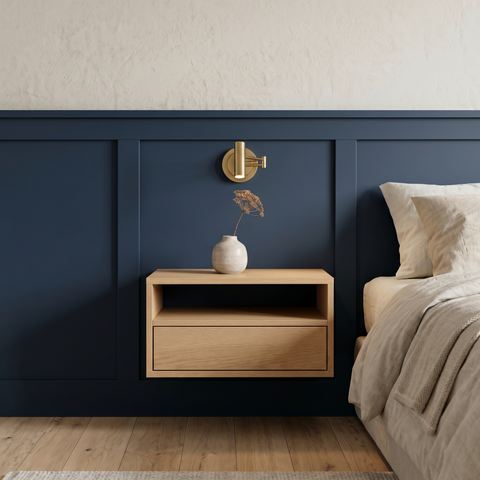
- Consider a floating or wall-mounted design to keep the floor clear and the room feeling open.
- Look for a table with a drawer to keep clutter off the surface.
- Keep the styling minimal — one lamp, one book — for a calmer, larger-feeling room.
This pared-back approach sits naturally within the calm, natural aesthetic of Japandi design. If that look appeals to you, read our guide to what Japandi style is.
Choosing a bedside table that lasts
Finally, size is only half the decision — the material matters just as much for something you’ll use every day for years. A solid oak bedside table brings warmth, durability, and a surface that ages beautifully. At FUKUI, each piece is handcrafted from solid oak in Poland, available in three widths to suit your bed and your room. Browse the full range of nightstands and bedside tables, or learn more about how we work on our About page.
Frequently asked questions
What height should a bedside table be?
A bedside table should sit roughly level with the top of your mattress — usually between 50 and 70 cm tall. Measure from the floor to the top of your mattress and choose a table whose surface lands within about 5–8 cm of that height.
How wide should a bedside table be?
Most bedside tables are 40–60 cm wide. Choose around 40 cm for small rooms or narrow gaps, 50 cm for a standard double bed, and 60 cm for a king-size bed or a larger room.
Should a bedside table be higher or lower than the bed?
Ideally it should be level with the top of the mattress. If you must choose, slightly higher is generally more comfortable and practical than noticeably lower.
What is the standard depth of a bedside table?
Most bedside tables are 30–45 cm deep — enough for the essentials without protruding awkwardly into the room. In small bedrooms, check the clearance between the bed and wall first.
Do bedside tables need to match?
Not necessarily, but a matching pair either side of the bed creates a calm, symmetrical look. In smaller rooms, a single well-proportioned bedside table works just as well.