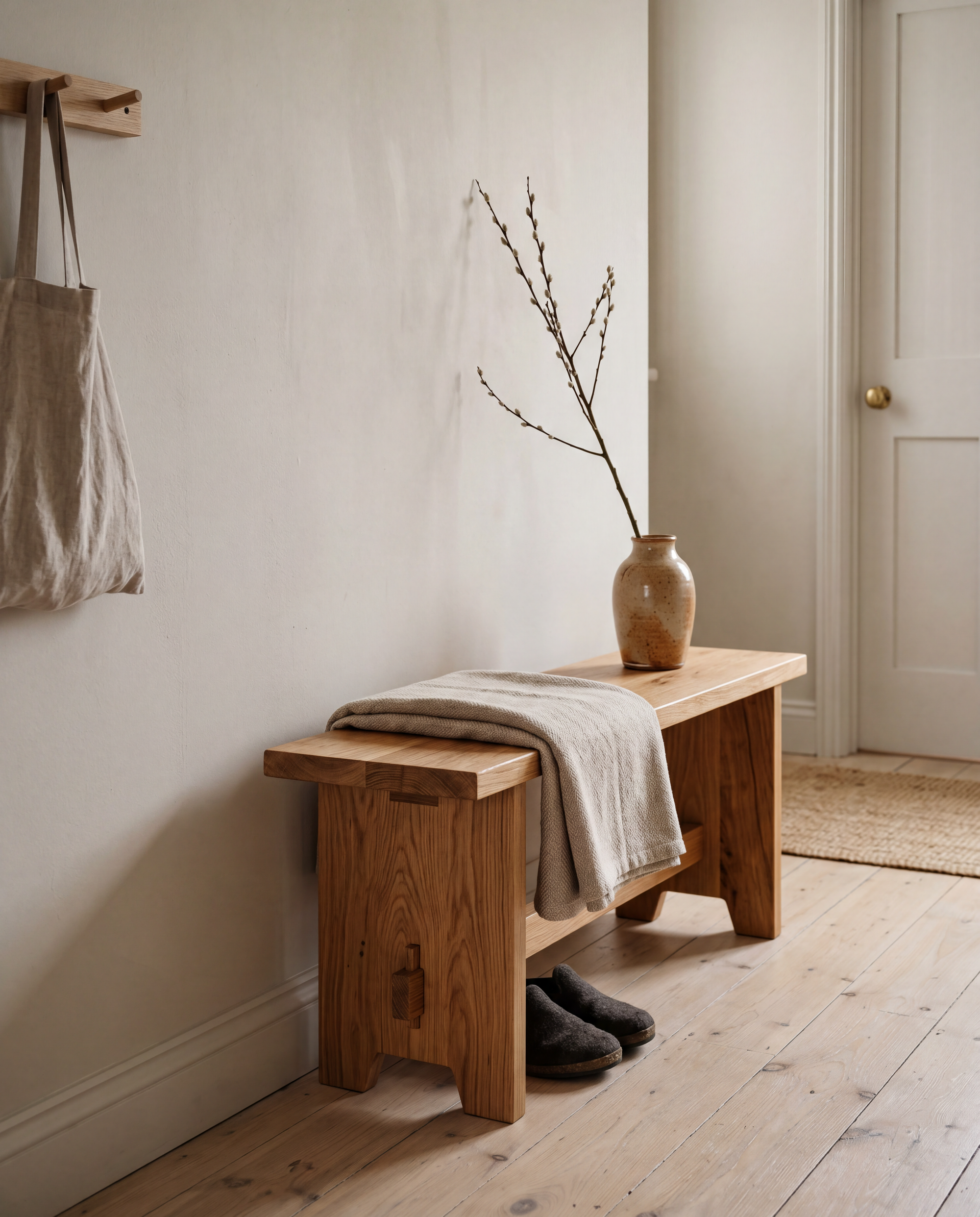


A floating nightstand is the quickest way to make a bedroom feel lighter: the floor stays clear, cleaning takes seconds, and the piece looks like it grew out of the wall. The only thing standing between you and that effect is twenty minutes with a drill. This guide covers the three wall types you are likely to meet, the right mounting height, and the mistakes we see most often.
What is in the box
Every wall-mounted FUKUI bedside table ships with a hidden steel bracket, screws and plugs rated for brick and concrete, a paper drilling template, and printed instructions. The bracket carries the load; once the cabinet slides onto it, no metal is visible from any angle. Rated load is 20 kg on the top and 10 kg in the drawer — books, a lamp, a carafe and a phone are nowhere near the limit.
The right height
Mount the nightstand so its top sits level with your mattress, or up to 5 cm above it. Measure from the floor to the top of the mattress while it is compressed the way you actually sleep on it, then subtract the cabinet height to find the bottom edge — the drilling template marks the rest. For most beds this lands between 55 and 65 cm from the floor.
Drywall (plasterboard)
Drywall is fine — if you fix into something solid behind it. Two options:
Into studs. Find the timber or metal studs with a stud finder, and align at least one bracket screw with a stud. A single stud plus one heavy-duty hollow-wall anchor comfortably carries a loaded nightstand.
Hollow-wall anchors. No stud where you need it? Use rated metal toggle or expanding anchors (not the plastic plugs supplied for masonry — those are for brick). Choose anchors rated at 25 kg or more each, and use every hole in the bracket. Double plasterboard is stronger than single; 9 mm single-layer board on an old partition deserves extra caution — find the stud.
Brick
Use the plugs and screws in the box. Drill with a masonry bit on hammer setting, blow the dust out of the hole, insert the plug flush, and drive the screw home. One tip: avoid drilling into mortar joints — aim for the middle of a brick, where the plug grips best.
Concrete
The strongest wall of all, and the hardest to drill. You will want a hammer drill; a regular drill with a masonry bit will get there, slowly. The supplied plugs are rated for concrete — the same routine as brick, minus the worry about joints.
The five common mistakes
1. Skipping the level. The template is straight; walls and floors rarely are. Level the template, not the skirting board.
2. Plastic plugs in plasterboard. Masonry plugs spin uselessly in hollow walls. Use proper hollow-wall anchors.
3. Drilling through a cable. Sockets and switches usually feed straight up or down. A cheap cable detector buys peace of mind.
4. Mounting before deciding the bed. If a new mattress is coming, mount after it arrives — heights differ more than you would think.
5. Half-tightened screws. The bracket should sit dead flat against the wall before the cabinet goes on. Any wobble now is amplified later.
Renting? You have options
Four small holes are a five-minute fill-and-paint job when you move out — far less visible than the shelf most landlords expect. If drilling is truly off the table, our freestanding nightstands like the Kanazawa or Akita give the same solid-oak calm with nothing but gravity involved.
Still unsure?
Send us a photo of your wall and we will tell you exactly what to use — write to the workshop, we answer within 24 hours on working days. And if your wall needs a non-standard width, every piece can be made to order to the centimetre.

Michał · founder, FUKUIDesigns the pieces, chooses the boards, writes the journal. Questions: info@fukui.store